10 Common UAE Corporate Tax Calculation Mistakes Businesses Make
Following the implementation of UAE’s corporate tax legislation, businesses operating throughout all emirates have to adjust their practices on closing accounts, filing returns and calculating taxable income. Despite clear guidance from the Federal Tax Authority, UAE corporate tax calculation mistakes remain widespread, especially among small and mid sized companies handling their first filing cycle. These mistakes are typically not deliberate but are rather made because of misunderstanding the legislation or bad record keeping practices. Explore more about UAE corporate tax calculation from the experts.
Ask CA provides assistance to businesses in correcting UAE corporate tax calculation mistakes that could be detected by officials. This paper describes ten of the most common UAE corporate tax calculation mistakes that companies make and gives tips on how to prevent them.
1. Misunderstanding the Taxable Income Threshold
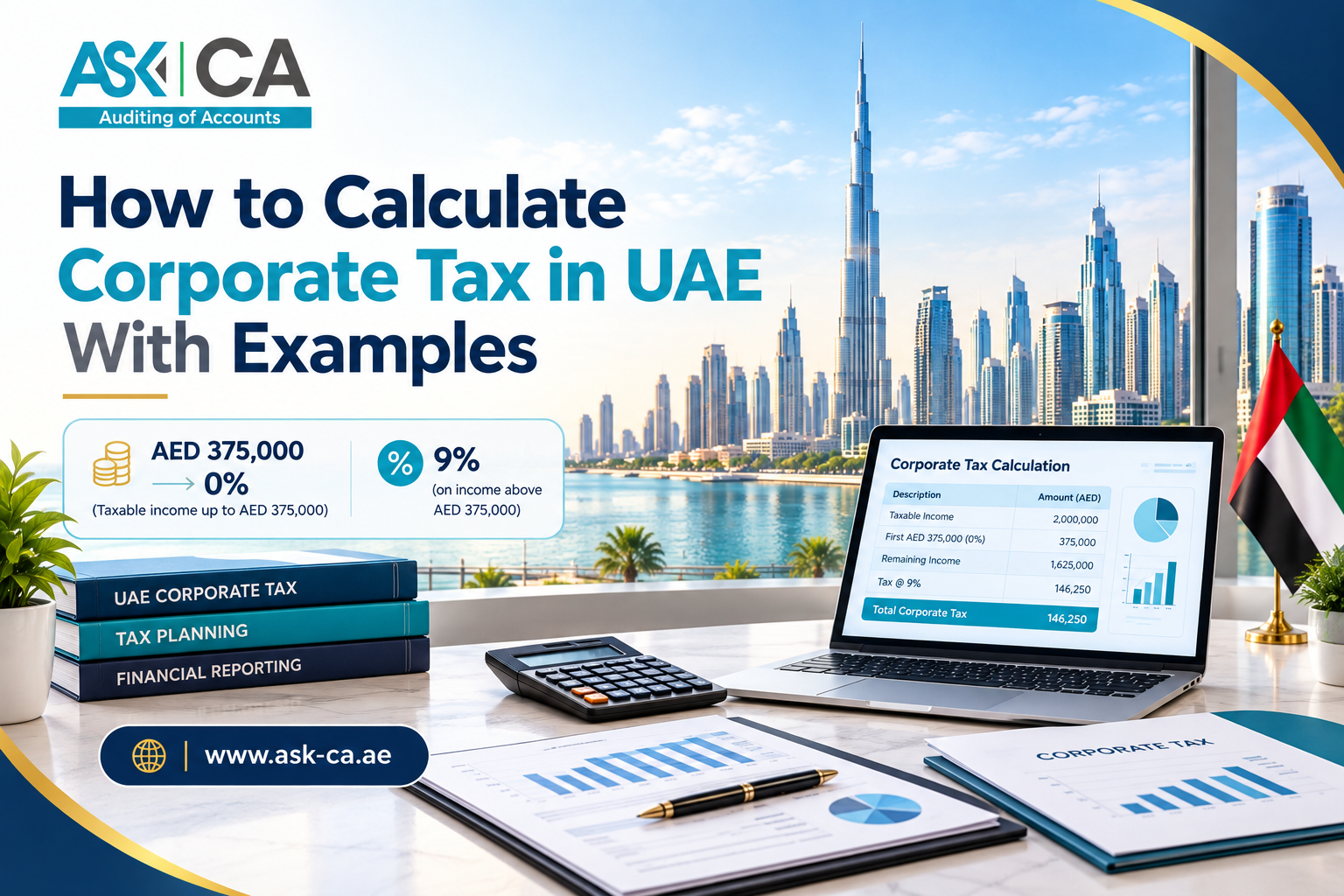
One of the most frequent UAE corporate tax calculation mistakes involves the AED 375,000 threshold. The reason for making such a mistake is that many business owners have a misconception that the AED 375,000 threshold applies to all businesses by default, while in fact it depends on the way income is allocated among various entities and if the business is a Free Zone Person or not.
2. Incorrect Classification of Free Zone Income
Free Zone businesses generally fall under the 0% rate, yet only in case they meet the stringent criteria of Qualifying Free Zone Person. One of the most frequent reasons for UAE corporate tax calculation mistakes is the misapplication of the 0% tax rate to non-qualifying income, for instance, income generated through mainland activities without satisfying the de minimis criteria. Careful review of income types helps avoid UAE corporate tax calculation mistakes.
3. Failing to Adjust Accounting Profit Correctly
The taxable income should not be confused with the accounting profit. Many companies often neglect the necessary adjustments for the exempt income, non-deductible expenses, or capital gains/losses that have not been realized yet. Neglecting these adjustments is one of the most common UAE corporate tax calculation mistakes made by businesses throughout the UAE.
4. Overlooking Related Party Transactions and Transfer Pricing
The transaction between the parties should be done using arm’s length pricing. Companies that fail to meet the required transfer pricing documentation may end up UAE corporate tax calculation mistakes, which will only come to light when the company undergoes an FTA audit.
5. Incorrect Treatment of Disallowed Expenses
In some cases, such as expenses related to entertainment and specific donations, a part of or all of the expenses is non-deductible in terms of tax. The non-deduction of such expenses in their totality is one of the most common UAE corporate tax calculation mistakes, as it tends to increase the deduction. Proper review of expenses helps avoid UAE corporate tax calculation mistakes in the final computation.
6. Errors in Depreciation and Capital Allowance Calculations
IFRS depreciation schedules do not necessarily match with tax depreciation. Companies that simply use the depreciation amount from accounting without any reconciliation are among those making some of the most avoidable UAE corporate tax calculation mistakes.
7. Missing or Late Registration with the FTA
The deadline for registration is linked to the licensing date, missing which will lead to automatic penalties. Late registration, though not an accounting mistake per se, is likely to lead to hurried and erroneous submission, making it a possible cause of UAE corporate tax calculation mistakes. The process of compliance preparation will help prevent UAE corporate tax calculation mistakes.
8. Ignoring Small Business Relief Eligibility Rules
The Small Business Relief can bring about total liability reduction for the eligible businesses; however, eligibility is determined by the revenue level and particular exemptions. Either way, the businesses could be making mistakes in claiming this relief or assuming that they are not eligible, which contributes to UAE corporate tax calculation mistakes. Proper verification of the eligibility will prevent UAE corporate tax calculation mistakes.
9. Weak Documentation and Recordkeeping
The accuracy of corporate tax calculation depends on the accuracy of the documentation. Lack of proper documentation like invoices and bank statements results in UAE corporate tax calculation mistakes, since incomplete data forces businesses to estimate figures instead of reporting them precisely.
10. Not Reviewing Group Relief and Tax Grouping Options
However, companies having multiple organizations in UAE often fail to utilize the Tax Group structure that would have simplified the process and provided an offset to the losses incurred in other entities. This oversight constitutes a strategic error that may lead to UAE corporate tax calculation mistakes.
Quick Comparison: Correct vs Incorrect Approach
| Area | Common Mistake | Proper Way to Do It |
| Threshold for taxation | Applying exemption automatically | Evaluate whether related parties and Free Zone apply |
| Income from Free Zone | Applying 0% to all income | Evaluate whether Qualifying Income conditions apply |
| Accounting profit | Using it as taxable income without adjustment | Make all necessary tax adjustments |
| Transactions with related party | Not following transfer pricing principles | Document transactions at arm’s length |
| Disallowed expenditures | Claiming them as deductions fully | Claim them up to limit |
| Depreciation | Using accounting figures without adjusting | Adjust depreciation according to tax rules |
| Tax registration | Late registration | Do it by deadline |
| Small Business Relief | Assumption about the eligibility for it | Evaluate revenue thresholds |
| Accounting records | Inadequate and incomplete | Keep reconciled and audit-ready records |
| Tax Group | Not taking it into account | Evaluate Tax Group eligibility annually |
Why These Mistakes Matter
UAE corporate tax calculation mistakes computation done by UAE corporations may not only have potential legal implications but could also negatively affect the planning process as well as cause further delays during audits and attract increased scrutiny from the FTA in subsequent reporting periods. Knowing the factors that contribute to UAE corporate tax calculation mistakes would allow businesses to avoid them.
How Ask CA Can Help
The team at Ask CA provides help with the review of tax calculations and helps in correcting UAE corporate tax calculation mistakes made by any authority. No matter whether you are submitting your first-ever corporate tax return or checking back one submitted earlier for possible mistakes, it always pays to seek professional assistance beforehand, since rectifying UAE corporate tax calculation mistakes later on will cost you much more.
If you need an independent review of your corporate tax calculations, then do contact Ask CA.
Why These Mistakes Matter
In addition to possible fines and penalties, UAE corporate tax calculation errors committed by companies in the UAE will create problems with the financial plan, cause audit delays, and draw further scrutiny from the FTA in the next accounting period. Knowing the reasons for making mistakes when calculating the UAE corporate tax can help companies file their tax returns more accurately and avoid compliance problems.