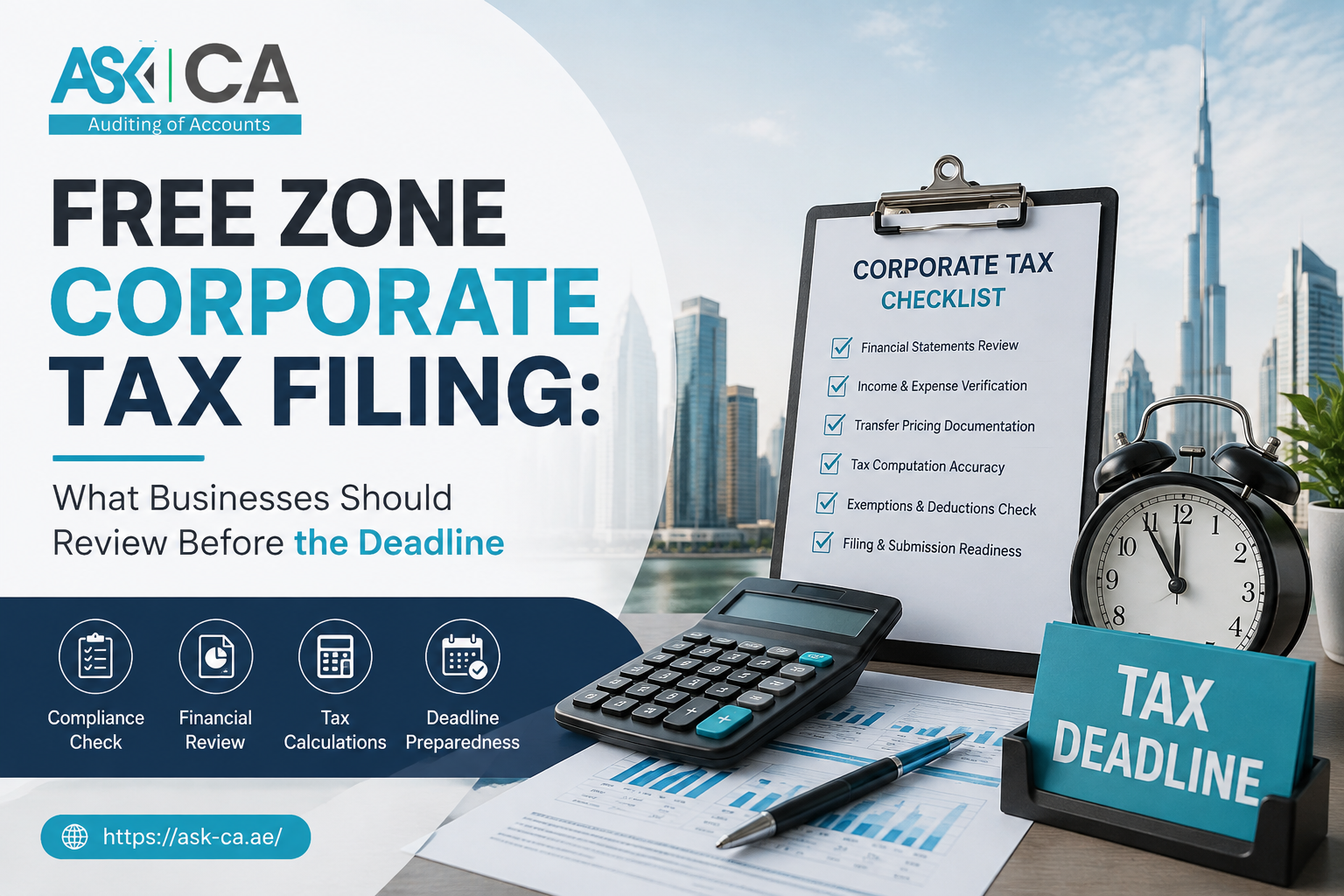
For those organizations which run their businesses in Dubai, Abu Dhabi, Sharjah and other free zones in UAE, Corporate Tax compliance cannot be taken as an afterthought any longer. This is true even for organizations which enjoy 0% Corporate Tax benefit offered by the UAE for their qualifying income.
The important thing to note here is that just because one files his/her taxes for free zone corporate tax filing, it does not mean that there is no requirement for filing taxes.
What Is Free Zone Corporate Tax Filing?
Free zone corporate tax filing is the mechanism by which an UAE Free Zone entity communicates its financial and tax position to the Federal Tax Authority.
A Qualifying Free Zone Person (QFZP) is eligible for exemption from Corporate Tax at the 0% rate on Qualifying Income. Non-Qualifying Income, however, may be taxed at the standard rate of 9%.
The difference in rates means that the UAE Free Zone corporate tax return is far more than just completing a tax form. Companies must determine what income qualifies, whether they still meet the requirements of being a QFZP and whether they have the necessary documentation to support the FTA position.
When Is the Free Zone Corporate Tax Filing Deadline?
In the context of the UAE Corporate Tax regime, it is worth noting that a Taxable Person has nine months after the expiration of its Tax Period to file its Corporate Tax Return and pay any Corporate Tax liability.
As an illustration, for a company whose Tax Period expires at the end of 31 December 2026, it will usually have up to 30 September 2027 to file its Corporate Tax Return.
It is important to state that the actual deadline for filing a UAE corporate tax return depends on the Tax Period of the firm in question.
What Should Free Zone Companies Review Before Filing?
1. Confirm Your QFZP Status
One must not take for granted that being a holder of a license within the Free Zone will ensure the application of the 0% tax rate automatically.
The firm applying for the QFZP status needs to evaluate the conditions associated with it, which include among others the eligible and ineligible activities, the sources of income and so forth.
2. Separate Qualifying and Non-Qualifying Income
An extremely vital part in corporate taxation for free zone companies is analysis of revenue according to their activity and the kind of clients.
In order to qualify, income can be charged at a 0% rate, but income that does not fit into the category of qualifying income can be taxed at 9%. It is not just a matter of QFZP obtaining the regular AED 375,000 0% rate on non-qualifying taxable income.
This way, your accounting documents must allow you to analyze all revenues and transactions.
3. Review Your Business Activities
It is necessary to check whether the activities done by the company coincide with those used in order to justify its tax treatment.
This is especially crucial when it comes to businesses with different income sources. In case of a Dubai or Abu Dhabi free zone company, although it may conduct a simple licensed activity, the actual operations it conducts are more complicated.
4. Check Your Accounting Records
Prior to preparing the corporate tax return for UAE free zones, ensure your accounting records are reconciled with any other documents.
Consider:
- Records of income and expenses
- Bank records
- Invoices and contracts
- Transactions between related parties
- Fixed assets
- Wages and other business expenses
- Customers’ and suppliers’ records
- Intercompany transactions
- Documents to support any tax adjustment
FTA says that generally all such records should be kept for at least seven years from the end of the relevant Tax Period.
5. Watch the 2026 Distribution Rules
There is also a crucial 2026 development that impacts some QFZPs.
FTA Decision No. 6 of 2026 creates further compliance steps for QFZPs performing the qualifying activity of distribution of goods or materials within or from a Designated Zone. This will be effective for Tax Periods starting on or after 1 January 2026.
The businesses will be required to prepare an Agreed-Upon Procedures (AUP) report by a licensed independent UAE auditor. This is aimed at providing evidences regarding their qualifying resellers and, when necessary, the imports into a Designated Zone.
Thus, the preparatory work becomes especially vital for qualifying distributors.
Common Free Zone Tax Filing Mistakes
A business may create problems for itself through:
- The belief that a Free Zone license guarantees 0% tax automatically.
- Considering all of the income to be qualifying income.
- Filing without reconciliation of accounts.
- Disregarding related party transactions.
- Collecting relevant documentation only at the time of UAE corporate tax return.
- Not reviewing changes in the nature of the business.
- Disregard for other compliance requirements relevant to particular QFZPs.
Such problems may affect not only the filing of a free zone tax return UAE but also the business’ ability to substantiate its tax position.
How to Prepare for UAE Corporate Tax Filing
Identify your Tax Period and due date. Examine your financials and allocate income, assess QFZP status and reconcile your documentation.
If your business is located in a UAE Free Zone like DMCC, Jafza, Dubai South, IFZA, RAK Free Trade Zone, or other free zone, there may be different compliance requirements depending on your business operations, transactions and tax status.
Companies who are coming to their deadline for filing corporate taxes in free zones should consider an expert examination of their compliance situation to avoid problems when they file their return instead of waiting until FTA contacts you.
Frequently Asked Questions
Does a free zone company need to file the Corporate Tax Return in the UAE?
Yes, since Free Zone companies will be required to register and comply with UAE Corporate Tax. Meeting the criteria for 0% does not exempt the taxpayer from filing obligations.
When is the deadline for Corporate Tax Return?
In general, a Taxable Person must file his/her Corporate Tax return and make payments due within nine months after the end of the Tax Period.
Do all Free Zone companies pay 0% Corporate Tax?
No. The 0% Corporate Tax applies to Qualifying Income of a Qualifying Free Zone Person. Otherwise, 9% Corporate Tax could apply.
What are the penalties for filing a Corporate Tax return late?
The FTA warned that if a company fails to file a Corporate Tax return or pays Corporate Tax late, it could face an administrative penalty. Late Corporate Tax return filing or late Corporate Tax payment could result in a penalty of AED 500 per month or part thereof in the first 12 months and then AED 1,000 per month or part thereof after the thirteenth month.
Get Your Free Zone Corporate Tax Filing Ready
The best way to comply with free zones corporate tax is by preparing ahead of time. Assess your qualification, type of income, account details, supporting documentation, and anything else you may need based on your particular case.
For those in the UAE, completing their corporate tax returns in the UAE cannot be just about submitting an application on time. It has to be about providing proof for the tax filing submitted to the FTA.